GLP-1 injection guide: where and how to inject

Supplies, sites, the step by step sequence with a vial and syringe, weekly rotation, storage and sharps disposal.
✓  More than 10,000 patients
✓  No insurance required
✓  100% Online
✓  Free and discreet delivery
✓  Licensed US practitioners
Medically reviewed by a licensed US practitioner. Last updated September 2026.
Read this first. This page is general education. It does not replace the instructions for use that came with your medication, the approved product labeling, or the directions your own prescriber gave you. Devices differ and manufacturers revise their instructions. Before your first injection, read the instructions in your box and have your prescriber or pharmacist watch you do it once. If anything on this page contradicts your labeling or your prescriber, follow them, not this page.

What a GLP-1 injection actually is.

Semaglutide and tirzepatide are given as a subcutaneous injection, meaning into the layer of fat just under the skin rather than into muscle or a vein. That layer is shallow, the needle is short, and most people describe it as a pinch rather than pain.

Three places on the body are used for these injections, and the destination is the same whether the medication comes in a vial or a pen. What changes between products is the device, not the site.
Before you start

Set out five things and check the vial.

Supply
Your medication
A syringe
An alcohol wipe
A cotton ball or gauze
A sharps container
Why you need it
Checked for the right name, the right dose and an expiration date that has not passed
New and unused. Never reuse a syringe or a needle
For the vial top and for the injection site, allowed to air dry before you inject
For gentle pressure afterward if a drop of blood appears
An approved container for the used needle and syringe, within reach before you start
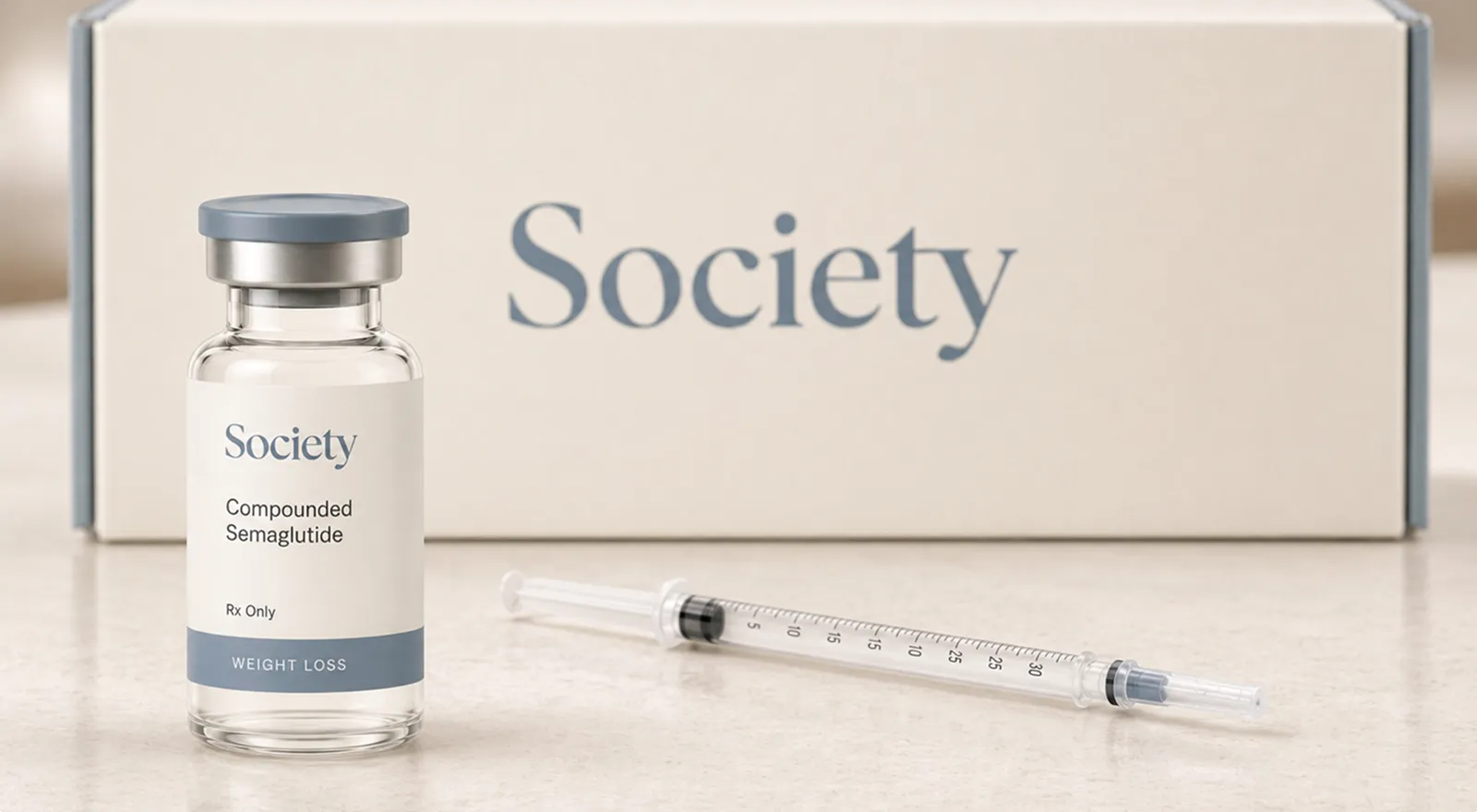
Wash your hands with soap and water and dry them. Then look at the liquid before you do anything else. Check the medication name, the dose and the expiration date on the label, and check that the liquid is clear. Do not use it if the liquid is not clear, if it is discolored, or if the container is damaged. Call your pharmacy instead of injecting it.

Confirm your dose in units before you draw. Your prescription is written in milligrams and your syringe is marked in units, so convert using the concentration printed on your vial, or use our GLP-1 dose calculator. If your number does not match your pharmacy label, stop and call before you draw.
Sites

Where to inject: abdomen, thigh or upper arm.

Site
Where exactly
Worth knowing
Abdomen
From just below the ribs to the top of the hip bones, staying at least 2 inches from the navel
The most used site. Easy to see, easy to reach, usually enough fat to inject into comfortably
Thigh
The front and outer surface of the upper leg, roughly a hand's width below the hip to a hand's width above the knee
Stay on the front and the outside. Avoid the inner thigh and the area over the knee
Upper arm
The back and outer surface, between the shoulder and the elbow
Most people cannot reach their own upper arm at a workable angle, so this site usually needs a second person
Avoid bruises, scars, stretch marks and irritated skin. Pick a clear patch of skin that is not tender, red, swollen, hard or broken. Also avoid any firm lump of thickened tissue caused by repeated injections in one spot, and tell your prescriber about it, because injecting into it changes how much medication your body absorbs. These medications are not designed to go into muscle or a vein.
Rotate the site weekly. Rotating means changing the exact spot you inject every week, not just changing which body area you use. Repeated injections into one small patch can thicken the tissue underneath and make absorption less predictable. Injecting into a different site does not change how the medication works.
Week
Week 1
Week 2
Week 3
Week 4
Week 5
Week 6
Site
Abdomen, lower left
Abdomen, lower right
Abdomen, upper left
Abdomen, upper right
Left thigh, front and outer
Right thigh, front and outer
Note
Keep at least 2 inches from the navel
At least 1 inch from last week's spot
Below the rib line
Below the rib line
Switch area to give the abdomen a rest
Then start the cycle again at week 1
If the upper arm is practical for yo
u, add it as weeks 7 and 8 with a second person injecting. If it is not, a four-week abdominal rotation followed by two weeks on the thighs works just as well. The rule that matters is that no single square inch of skin takes two injections in a row. A phone reminder on your injection day with the site written into it is enough to keep track.
Step by step

How to inject with a vial and syringe.

This is the general method for a vial and a syringe. Where the instructions for use supplied with your specific product differ from anything here, follow them rather than this page.

1. Wash and dry your hands. Soap and water, then dry fully before you handle anything.

2. Check the vial. Confirm the medication name, the dose, the expiration date, and that the liquid is clear. Do not use it if the liquid is not clear, if it is discolored, or if the vial is damaged.

3. Confirm your dose in units. Convert your prescribed milligram dose using the concentration printed on your vial. If your number does not match your pharmacy label, stop and call before you draw.

4. Wipe the rubber top of the vial with a fresh alcohol swab and let it air dry. Do not blow on it or wipe it with anything else.

5. Pull air into the syringe to the same number of units as your dose.

6. Push that air into the vial. With the vial upright on a flat surface, insert the needle through the centre of the rubber top and push the plunger down. This equalizes pressure and makes the liquid easier to draw.

7. Turn the vial upside down, keep the needle tip below the liquid line, and pull the plunger slowly back to your prescribed number of units.

8. Clear the air bubbles. With the needle still in the vial, tap the barrel so bubbles rise, then push them back into the vial. Re-check your number. A bubble takes up space, so a syringe with air in it holds less medication than the mark suggests.

9. Remove the needle and set the syringe down without letting the needle touch anything.

10. Clean the injection site with an alcohol wipe and let it dry completely. Injecting through wet alcohol stings.

11. Pinch a fold of skin between your thumb and fingers, and insert the needle into the pinched skin at a 90 degree angle in one steady motion.

12. Press the plunger down fully and steadily until the medication has been fully delivered and the syringe is empty.

13. Pull the needle straight out at the same angle it went in, and release the pinch. If a drop of blood appears, press gently with a cotton ball or gauze. Do not rub the site.

14. Drop the whole syringe, needle attached, straight into your sharps container. Do not recap it.
Avoid bruises, scars, stretch marks and irritated skin. Pick a clear patch of skin that is not tender, red, swollen, hard or broken. Also avoid any firm lump of thickened tissue caused by repeated injections in one spot, and tell your prescriber about it, because injecting into it changes how much medication your body absorbs. These medications are not designed to go into muscle or a vein.
Storage

How to store your medication.

What
Refrigerator temperature
Packaging
Freezing
Fridge placement
Room temperature
Compounded vials
Travel
The rule
Keep it refrigerated at 36°F to 46°F (2°C to 8°C)
Keep it in its original packaging until you use it, so it stays protected from light and stays identifiable
Never freeze it. Discard it if it has been frozen, even if it has since thawed
Not in the freezer compartment and not against the cooling element at the back of the fridge
Brand products carry a limited, time-boxed allowance printed in the carton. Follow the carton you were given rather than a number from a web page
Follow the storage window and beyond-use date your dispensing pharmacy printed on the label, which may be shorter than a manufacturer expiry
An insulated cooler with a gel pack that is not touching the vial or pen. Never in checked luggage, where the temperature is uncontrolled
Never warm medication in a microwave, in hot water or in direct sunlight. Some people find the injection more comfortable if the medication is not straight out of the fridge, but check your own labeling first, because the permitted time at room temperature differs by product and is not open-ended.

Sharps disposal. Used needles and syringes are not household waste. Place them into an approved sharps container immediately after use, at the place you injected, rather than carrying a used needle to another room. If you do not have one, a heavy-duty plastic household container with a tight-fitting, puncture-resistant lid can serve in the meantime, clearly labeled as containing sharps. Close it when it is about three quarters full. Do not recap a needle, do not put loose needles in household trash or recycling, do not flush anything, and do not use glass, a coffee can or a milk jug. Disposal routes are set at state and sometimes county level, so check with your local health department for the drop-off, mail-back or take-back option near you.
If something goes wrong

Six things that happen, and what to do.

What happened
A little blood at the site
A drop of liquid leaks out as you withdraw
You are not sure the full dose went in
The needle bends, or the pen will not press
You injected into the same spot as last week
Redness, itching or a small lump at the site
What to do
Common and not a problem. Press gently with clean gauze. Do not rub
Usually a small loss. Do not inject again to make up for it. Mention it to your prescriber
Do not repeat the injection. A double dose is a bigger problem than a partial one. Contact your prescriber
Do not force it. Discard it in your sharps container and call your pharmacy about a replacement
Watch that area for firmness or lumps and choose somewhere clearly separate next week
Common, and usually settles within a few days. Spreading rash, swelling of the face, lips or throat, or difficulty breathing are different and need immediate medical attention
If you miss your injection day, the rule depends on the medication. For tirzepatide, take it within 4 days and otherwise skip it and resume your normal weekly day. Keep at least 72 hours between two doses if you are changing which day you inject.

Society members can ask about technique at any point in treatment. Support typically replies within 24 hours at support@societyofyou.com or (888) 584-5602, and clinical questions go to a licensed US practitioner. If you are not a member, your pharmacist can usually demonstrate the device you were dispensed. It is a reasonable thing to ask for.
Questions

Injection questions.

Important safety information
GLP-1 based treatments may carry risks, including the potential for thyroid C-cell tumors. These medications should not be used by individuals with a personal or family history of medullary thyroid carcinoma (MTC) or Multiple Endocrine Neoplasia syndrome type 2 (MEN 2). Side effects may include nausea, headaches or dizziness, fatigue or changes in appetite, gastrointestinal discomfort, and injection-site reactions.

Compounded medications are not FDA-approved and have not been evaluated by the Food and Drug Administration for safety, efficacy, or quality.

Start with a provider who walks you through the first one.

Society is 100% online. A licensed US practitioner reviews your intake, your medication is dispensed through US licensed pharmacies, and delivery is free, discreet and takes 1 to 2 days. Technique questions go to support, which typically replies within 24 hours. The free 2-minute evaluation is where it starts, and no insurance is required.
Get started
© 2026 Society. All rights reserved.
* Individual results may vary, and not all patients will qualify for treatment. Always consult a licensed healthcare provider before starting or modifying any medical treatment.

Society facilitates access to consultations with independent, licensed healthcare providers who evaluate each patient and determine eligibility for treatment. Prescription products require an online medical evaluation. Medications are prescribed by independent physicians and dispensed by licensed U.S. pharmacies or a patient's preferred pharmacy. Only a qualified healthcare provider can determine whether a treatment is appropriate for an individual's specific medical needs.
Providers are licensed in the state where the patient is located at the time of consultation, and availability may vary by state.
Society's services are intended for individuals 18 years of age or older. Age verification may be required as part of the intake process.
‍Society partners with licensed U.S. pharmacies. Certain treatments may include compounded medications, which are not FDA-approved and have not been evaluated by the Food and Drug Administration for safety, efficacy, or quality. Compounded medications may be prescribed by a healthcare provider based on individual patient needs or during periods of drug shortages. FDA-approved GLP-1 medications—such as Ozempic® (semaglutide), Wegovy® (semaglutide), and Zepbound® (tirzepatide)—are not compounded. Society is not affiliated with, endorsed by, or sponsored by the manufacturers of these products. All trademarks and brand names belong to their respective owners.
GLP-1–based treatments may carry risks, including the potential for thyroid C-cell tumors. These medications should not be used by individuals with a personal or family history of medullary thyroid carcinoma (MTC) or Multiple Endocrine Neoplasia syndrome type 2 (MEN 2). Please consult a healthcare provider for complete prescribing and safety information.
Prescription medications are dispensed only when determined appropriate by a licensed healthcare provider following an online medical evaluation. No prescription is guaranteed, and treatment decisions are made solely at the prescriber's clinical discretion.
Statements on this website have not been evaluated by the Food and Drug Administration and are not intended to diagnose, treat, cure, or prevent any disease. Images shown are for illustrative purposes only; actual product appearance may vary.